
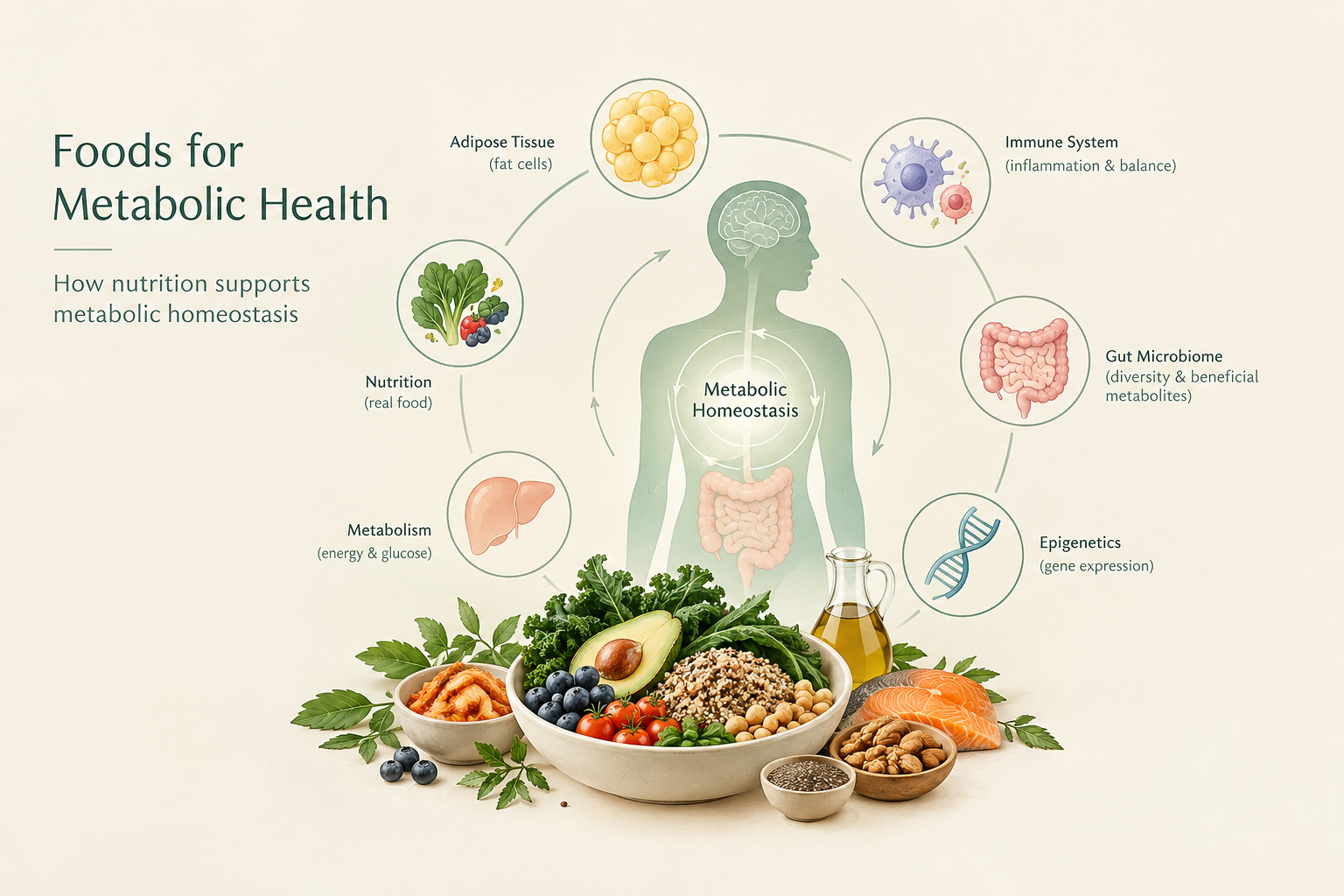
Weight gain doesn't affect metabolic health simply because there is “more fat.” The more interesting question is what happens to the tissue, immune system, gut microbiome and gene regulation as the body adapts to changes in nutrition and energy.
we talk about metabolic health, we often reduce the conversation to calories, weight or blood sugar. But your metabolism is much more complicated than a calorie counter. Your fat tissue, immune system, liver, pancreas, gut microbiome and even your gene expression are constantly communicating with each other to keep your internal environment stable.
This state of balance is called metabolic homeostasis.
Think of it as your body's internal thermostat. It is constantly making small adjustments to keep things such as glucose, energy availability, inflammation and nutrient use within a functional range. And when that communication becomes disrupted, metabolic health can begin to deteriorate.
The mechanisms connecting weight gain to metabolic disease are still being investigated, but one thing is increasingly clear: adipose tissue is not simply a place where the body stores excess energy. It is an active metabolic and endocrine organ that communicates with the rest of the body.
So, what does this have to do with the foods we eat?… Quite a lot.
1. Adipose tissue: your body fat is more than storage
For a long time, body fat was viewed primarily as an energy reserve. But adipose tissue is much more dynamic than that.
Adipocytes — fat cells — store energy, but they also release signaling molecules called adipokines that communicate with other tissues and participate in regulating metabolism and inflammation.
Imagine your adipose tissue as a warehouse. A healthy warehouse can receive, organize and store incoming supplies without disrupting the rest of the city. But if supplies keep arriving faster than the warehouse can comfortably handle them, the system has to adapt.
Adipocytes can enlarge, the surrounding tissue can change, and signals associated with inflammation can increase. In obesity, adipose tissue expansion is associated with immune-cell recruitment and chronic low-grade inflammation, which can interfere with insulin signaling.
This is one reason why adipocyte health matters for metabolic health.
The goal isn't simply to ask, “How much body fat does someone have?”
We also need to understand how that tissue is functioning.
And this is where the immune system enters the conversation.
2. The immune system and metabolic health

Your immune system isn't only responsible for fighting infections. It also participates in maintaining the body's everyday balance.
This relationship between metabolism and immunity is sometimes described as immunometabolism — the study of how immune and metabolic processes influence one another.
Think of metabolism and immunity as two departments in the same company. They have different jobs, but they are constantly exchanging information. When adipose tissue expands under conditions of overnutrition, immune cells can accumulate within the tissue and contribute to an inflammatory environment. In turn, inflammatory signals can interfere with insulin signaling and other metabolic processes.
This doesn't mean that inflammation is inherently bad, inflammation is an important protective response. The problem is when a response that should be temporary becomes persistent and poorly resolved.
That is why metabolic homeostasis is so important. Your body is constantly trying to bring these systems back toward balance.
Where does food enter the picture?
Diet can influence immune and metabolic signaling both, directly and indirectly.
Some components of food interact with cells and receptors in the body. Others reach the gut microbiome, where microorganisms transform them into metabolites that can communicate with the host.
This creates an enormous communication network:

And it works in the other direction too.
Metabolic state → immune environment → gut environment → microbiome
This is one reason why it is difficult to understand metabolic health by looking at a single nutrient in isolation.
3. Real food, the gut microbiome and metabolic health
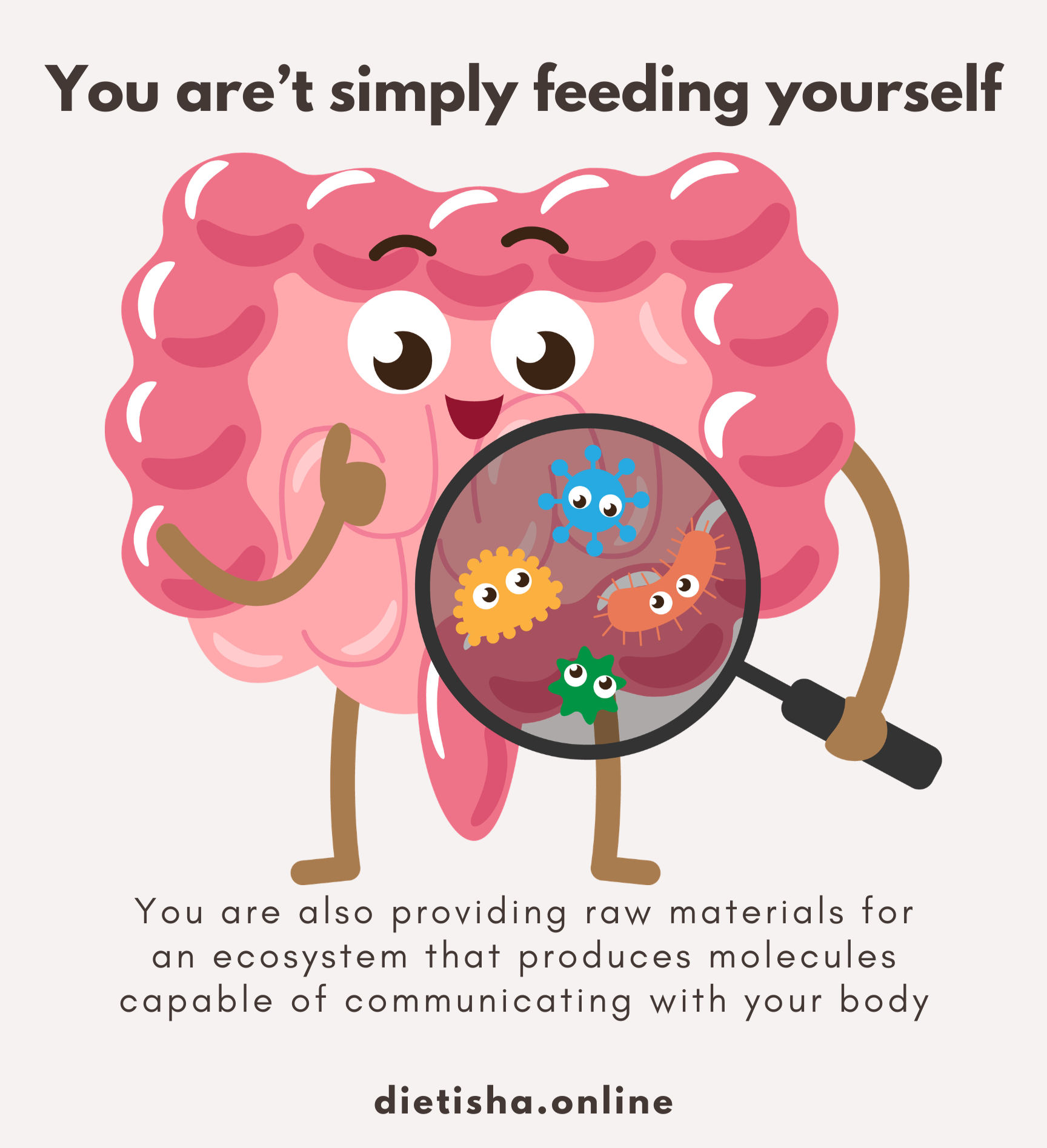
Think of your gut microbiome as a small ecosystem.
Your digestive system is home to trillions of microorganisms that interact with the food you eat, one of the most interesting examples involves dietary fiber.
Certain fibers reach the colon without being completely digested in the small intestine. There, gut microorganisms can ferment them and produce compounds called short-chain fatty acids (SCFAs), including acetate, propionate and butyrate. These compounds can act as signaling molecules and influence intestinal, immune and metabolic processes.
Think of your gut microbiome as a small ecosystem.
You aren't simply feeding yourself. You are also providing raw materials for an ecosystem that produces molecules capable of communicating with your body.
This is one reason I emphasize real food rather than thinking only in terms of isolated nutrients. Whole and minimally processed foods can provide combinations of fiber, vitamins, minerals, fatty acids, amino acids and plant compounds that interact with the body — and with the microorganisms living inside it.
That doesn't mean supplements are useless, supplements can be appropriate in specific situations, but a supplement containing one isolated nutrient is not necessarily equivalent to the complex food matrix from which that nutrient originally came.
For metabolic health, the bigger question is often not:
“What single nutrient should I take?”
but:
“What kind of environment am I creating for my metabolism, immune system and gut microbiome over time?”
4. Your genes are part of the conversation — but they aren't the whole story
Genetics also influences metabolic health, some people are more genetically predisposed to certain metabolic conditions than others, but genes don't operate in isolation. This is where epigenetics becomes particularly interesting.
A simple analogy is to think of your DNA as a massive cookbook. You don't rewrite the recipes every time your environment changes, instead, different biological signals can influence which recipes are easier or harder for your cells to access.
Nutrition, metabolism and other environmental signals can participate in these regulatory processes.
Epigenetics refers to mechanisms that can influence how genes are expressed without changing the underlying DNA sequence.
Research has identified associations between obesity, metabolic dysfunction, immune-related pathways and epigenetic changes, including DNA methylation. However, an important scientific distinction is that an association does not automatically prove that the epigenetic change caused the metabolic problem.
The gut microbiome adds another layer.
Some microbial metabolites, including SCFAs, can influence epigenetic regulation such as histone modification, creating another possible connection between what we eat, our microbiome and how genes are regulated.
So we end up with something that looks less like a straight line and more like a web:
Food ↔ microbiome ↔ immune system ↔ adipose tissue ↔ metabolism ↔ gene regulation
And this is exactly why metabolic health cannot always be reduced to one food, one supplement or one number on a scale.
So, what are the best foods for metabolic health?
There isn't one universal list.

But there are nutritional patterns that can support the biological systems involved in metabolic health.
A practical starting point is to regularly include:
Vegetables and fruits for fiber and a variety of micronutrients and plant compounds
Legumes and whole grains for fiber and complex carbohydrates
Nuts and seeds for unsaturated fats, minerals and other nutrients
Fish and other protein sources to provide amino acids and, depending on the food, beneficial fatty acids
Fermented foods, when tolerated, as part of a diverse diet
Adequate protein distributed throughout the day according to individual needs
A variety of plant foods to provide different substrates for the gut microbiome
But “healthy food” isn't a universal prescription.
The amount, combination and timing of foods can matter, and individual nutritional needs can differ depending on factors such as age, activity, body composition, metabolic status, medications, health conditions and overall dietary pattern.
That is why I don't believe in a one-size-fits-all diet.
Metabolic health is an ecosystem, not a single number
When we put all of these pieces together, metabolic health starts to look very different.
It isn't simply:
weight → calories → metabolism
It is a much larger system involving:
nutrition + adipose tissue + immune signaling + gut microbiome + genetics + epigenetic regulation + lifestyle + environment
And this is where personalized nutrition becomes interesting…
In my work, I use nutritional information alongside personalized biological data to identify areas that may deserve closer attention — for example, potential nutritional requirements involving vitamins, minerals, antioxidants, amino acids and fatty acids, as well as information related to the gut microbiome and other biological markers.
The purpose isn't to create a permanent list of “good” and “bad” foods. It is to use information to make targeted nutritional adjustments for a specific period of time, then reassess rather than assuming that the same nutritional strategy will work forever.
I also want to make an important distinction: personalization does not mean that every biological marker available today has been scientifically validated as a basis for changing someone's diet. Some areas of epigenetic and microbiome testing are promising, while others still require stronger clinical evidence.
That distinction matters to me because personalized nutrition should be curious about new science without pretending that unanswered questions have already been solved.
The Dietisha approach

This is ultimately how I think about metabolic health: There is no single “metabolic health food.” There is a biological system.
And that system is constantly responding to what you eat, how you live, your genetics, your microbiome and many other factors.
The goal isn't to control every biological variable. It is to create the conditions that allow your body to maintain metabolic homeostasis — that dynamic state of balance in which different systems can communicate, adapt and perform their jobs.
So instead of asking:
“What is the perfect diet?”
I think a more interesting question is:
“What does my body need right now?”
Because your metabolism isn't static.
And neither should your nutrition be.
